
Why Ignoring the Role of Gender in Mental Health Is Failing Women
Mental health care has traditionally been approached with the assumption that everyone has the same experiences in the world, regardless of their gender. Therefore, the current standards fail to take into account the realities of women’s lives and the way their experiences are shaped by upbringing, caregiving, and societal expectations. Thus, when the role of gender in mental health is overlooked, women’s distress is misunderstood and minimized. Following International Women’s Day, it’s time we recognize that women’s mental health differences are about acknowledging the context that shapes their experiences and working towards gender-specific mental health care models that can truly address the challenges they face.
Mental Health Is Not Gender-Neutral
Mental Health is a diverse domain, and individual experiences are shaped by social, cultural, and biological factors. This is why men and women respond differently to psychological stress.
Traditional mental health models were developed largely based on evidence derived from predominantly male subjects. This led to the formation of diagnostic criteria and treatments that may not fully reflect women’s experiences. As a result, the one-size-fits-all approach to mental health often fails women and makes the consideration of gender in mental health more pertinent.
Why Does Mental Health Often Look Different For Women?
The experiences of human beings in this world are influenced by many different factors, amongst which gender is one of the most significant. Gender shapes socialization, the roles that we are expected to fulfill, and the kind of challenges we will face in our lives.
Women from a young age are socialised into a specific caregiving role wherein they are taught to be responsible for the needs of the people around them without ever saying ‘no’. As a result, women take on more roles than they can manage and suffer through a great deal of psychological burden.
Women’s mental health is also largely influenced by hormones that change throughout their lives. From puberty to the onset of menstruation, pregnancy, postpartum, and then menopause, each phase brings with it a different kind of emotional adjustment that can influence one's mental health. Moreover, women around the world are more exposed to gender-based violence and harassment, which further highlights the role of gender in mental health.
The Invisible Weight of Social Expectations
Women’s mental health problems often go unnoticed, both by themselves and the people around them. This can be attributed to how they have been culturally conditioned to prioritize others’ needs before their own. So even if they feel distressed or sad, they are more likely to brush it away. The discourse around gender in mental health is also specifically important because society rewards self-sacrifice displayed by women more than men, which they internalize over time.
As a result, women have set very high expectations for themselves when it comes to motherhood and caregiving, where they aim for perfection and nothing less. In the process of working towards perfectionism, women let go of their own mental health needs and fail to set boundaries.
Why Do Women Feel Misunderstood in Therapy?
Many women feel misunderstood in therapy because their emotional reactions, such as irritability, sadness, and anxiety, are very easily labelled as ‘stress-related’ or just them being ‘overly emotional.’ These long-held notions about women’s mental health are also what hold them back in therapy. Other than this, structural and systemic issues are rarely taken into account, like caregiving burden and workplace inequalities, and are thought of as personal shortcomings.
Therapists may also fail to understand the role of gender in mental health. Women face issues pertaining to burnout from juggling multiple roles, invisible labor at home, and relational stress in families, which is often not explored in therapy.
Additionally, many therapeutic models emphasize qualities like independence and assertiveness without addressing the social consequences this will have on women. For instance, a woman who chooses to assert herself at work may face repercussions, and when such social realities of women are ignored in therapy, they may feel disconnected and unsupported.

5 Things That Get Missed When Gender in Mental Health is Ignored
Misdiagnosis or Incomplete Diagnosis:
Women’s symptoms look very different when compared to men's. Fatigue, irritability, and somatic complaints often do not fit the traditional diagnostic models based on male experience. This leads to mislabelling, misdiagnosis, or completely missing the issue at hand.
Social Stressors Being Misunderstood as Personal Failures:
There are many challenges that women face, which are rooted in unequal caregiving responsibilities and workplace inequalities that are deemed as personal failures or the inability to cope. These real causes of social distress are not taken into account.
Unrecognized Trauma:
Research claims that gender discrimination was associated with depression, post-traumatic stress, and anxiety in women. Such subtle, yet chronic experiences of discrimination, harassment, and emotional labor have detrimental consequences on the mental health of women.
Neglecting Reproductive Mental Health:
Mental health issues in women may stem from problems related to menstruation, pregnancy, postpartum, and menopause. But because these issues do not fulfill the generic therapeutic models, they are often overlooked.
Lack of Validation for Everyday Struggles:
Women are taught to conform to a role that entails extensive emotional labor, caregiving exhaustion, and juggling multiple roles at once. When such demanding labor is not validated in both everyday life and therapy, women start feeling undervalued.
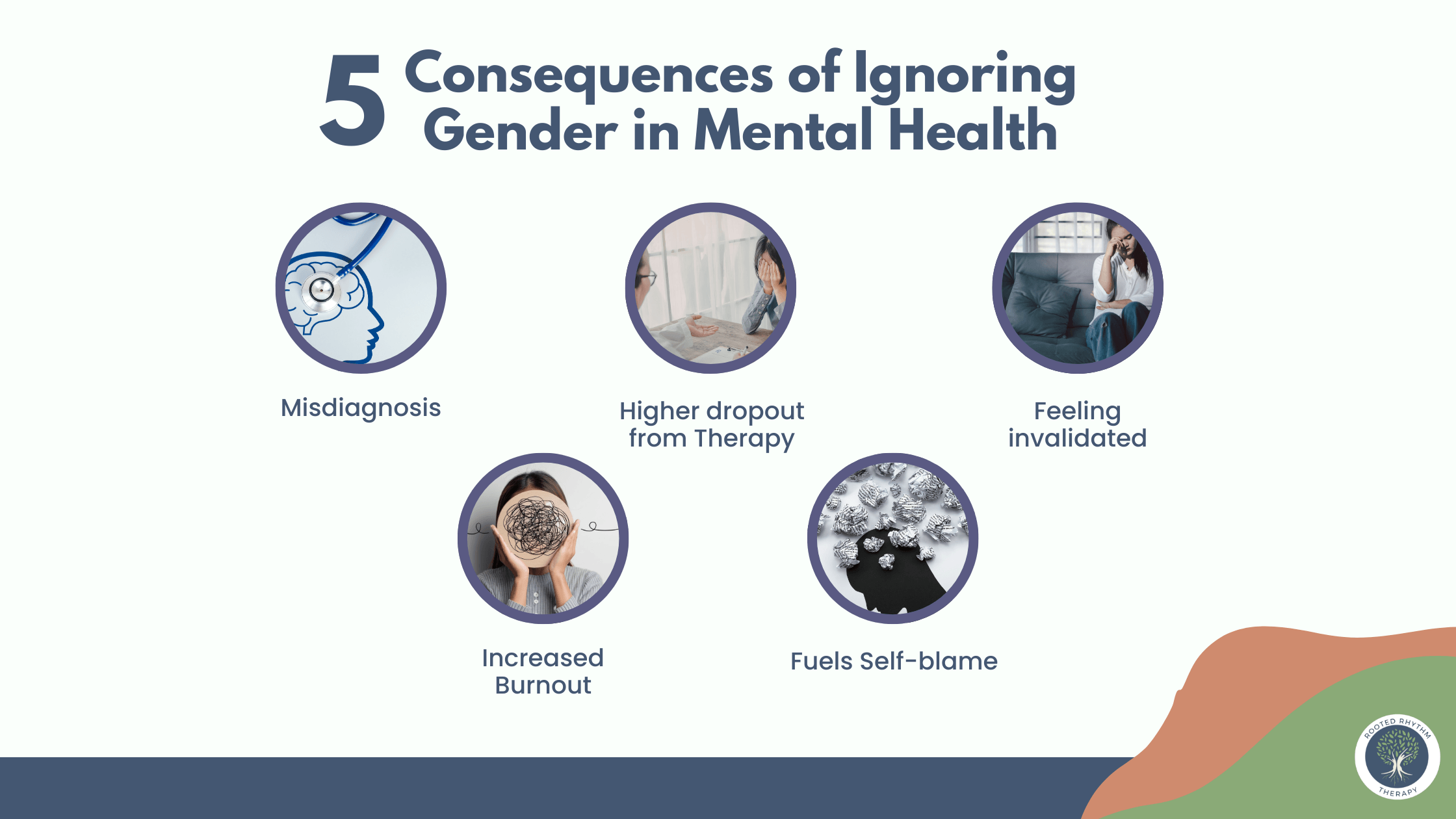
5 Key Consequences of Ignoring Gender in Mental Health Care
Feeling Unseen or Invalidated:
Women’s experiences are often dismissed when the role of gender is not taken into account.
Delayed or Ineffective Treatment:
High rates of misdiagnosis due to generic approaches in therapy can prevent appropriate care.
Increased Burnout:
Unaddressed stressors and chronic emotional labor lead to exhaustion.
Higher Dropout Rates From Therapy:
Women may leave therapy when they feel like they’re not being understood and supported.
Framing Normal Response As Personal Weakness:
Mental health care that does not take gender into account can reinforce the idea that women’s distress is a personal shortcoming, rather than a response to systemic pressures.
What Changes When Gender Is Considered in Mental Health Care
The first step towards providing mental health care is validating emotions. When gender is put at the forefront of mental health care, validation of women’s emotional labor and invisible responsibilities becomes much easier. This makes women feel seen and valued.
Moreover, gender-informed therapy for women is important as it addresses both personal experiences and the social context that influences the lives of many women. This means that women are not blamed if they feel irritable or restless. Rather, the underlying reasons are explored. Furthermore, conversations around boundaries, identity, and self-worth allow women to better understand their needs.
Building An Inclusive Mental Health Framework
To ensure that women are not left out of the mental health framework, it is important to train therapists and clinicians in gender sensitive care. Further research that actively studies women’s experience is also necessary in order to devise diagnostic modalities and treatment plans that take gender into account. This will eventually help in the delivery of appropriate care to women.
At Rooted Rhythm, we offer therapy that considers women’s lived experiences, emotional labor, and ground realities. We believe that it is important to create healing spaces that shift the narrative from ‘fixing women’ to actually understanding the pressures that they navigate. Our trained therapists apply somatic and trauma-informed approaches in mental health care that acknowledge the role of gender in mental health care so that women feel supported and seen.
FAQ’s
Q1. Why does gender matter in mental health?
Gender matters in mental health because it affects how people respond to psychological stress in their daily lives. Gender also influences how people experience stress and trauma, and thus mental health care needs to account for those differences.
Q2. How does ignoring gender in mental health affect women?
When gender is not taken into account, women can feel misunderstood. They can also be incorrectly diagnosed and thus insufficiently treated.
Q3. Do women experience mental health challenges differently from men?
Yes! Women face societal pressures, emotional labor, and caregiving expectations that are different from those of men and thus affect their mental health differently.
Q4. What is gender-informed therapy?
Gender-informed therapy recognizes the role of gender and how it shapes emotional well-being and healing.
Written by the Rooted Rhythm team, a therapy practice that focuses on gender-informed therapy for women. We recognize the role of gender in women's emotional experience and help them understand and navigate their stressors to lead fulfilling lives.
Do you have a highly sensitive child?
We have created a course (Tuned In Parenting Course) that covers all from parenting techniques, to self-regulation, setting expectations, healthy boundaries and so much more. If you feel like starting with a sneak peak visit our Instagram page or check our mini courses: The Highly Sensitive Child and Parenting Essentials. We created these resources with care, and our hope is that they bring you clarity, support, and a sense of ease in your parenting journey.