
How Juggling Multiple Roles Affects Women’s Emotional Health: Signs that you are struggling with Emotional Overload

Many women carry a very particular kind of exhaustion with themselves. This is not attributable to a single tough day, but it comes from years of taking care of others, holding space for them, and managing a bunch of things together. Beneath competence and capability lies this sort of exhaustion, which can be termed as emotional overload. Over time, emotional overload can accumulate and leave women stretched too thin, unseen, and disconnected from themselves. At Rooted Rhythm, we like to remind women that emotional overload is not a personal failure. Rather, it is a nervous system response to carrying too much for too long that needs to be tended with care and dignity.
Why Do You Feel Exhausted Even When You’re ‘Handling Everything?’
You might be handling too many things together. From work deadlines to messages and family meetups! And while all of it may look seamless on the surface, there is a chance that beneath all of that efficient execution, your nervous system is getting overworked. You may not realize it at the time, but this eventually leads you into a state of emotional overload.
Emotional Overload can be explained as the exhaustion that piles up from years of overexertion, where you may feel like you’re carrying too many emotions at the same time. As a result, the mind and body become overstimulated. It can also be seen as a persistent sense of being mentally and emotionally on edge, even when you are trying to rest.
How is Juggling Multiple Roles Affecting Your Emotional Health as a Woman?
As a woman, you find yourself in a multitude of roles that you no doubt are fulfilling remarkably. As a professional in their field, a friend, a partner, and a caregiver, women are juggling many roles at once. While many women are great at doing many things at once, if adequate emotional transition is not provided, this constant role switching can quickly lead to burnout. Over time, women also start equating their worth with how well they perform each role, and it only leads to overwhelm.
Emotional exhaustion from multiple roles may show up as chronic stress, irritability, or tension. When everything gets a little too much, women may feel numb and enter a state of shutdown. This is when it gets difficult for them to identify their own needs amongst everyone else’s.
Why Are Women More Vulnerable to Emotional Overload
Women and men both find themselves in hectic routines and challenging roles in the present day. But more often than not, women find themselves in a place of emotional overload and overwhelm as compared to men. This stark difference can be attributed to the way that women are socially and culturally conditioned from a young age.
They are taught to be responsible for others around them, to be strong, and to sacrifice their own needs for the sake of others. Women are also praised for their endurance rather than emotional honesty, which eventually conditions them to a habit of self-neglect and eventually emotional overload.
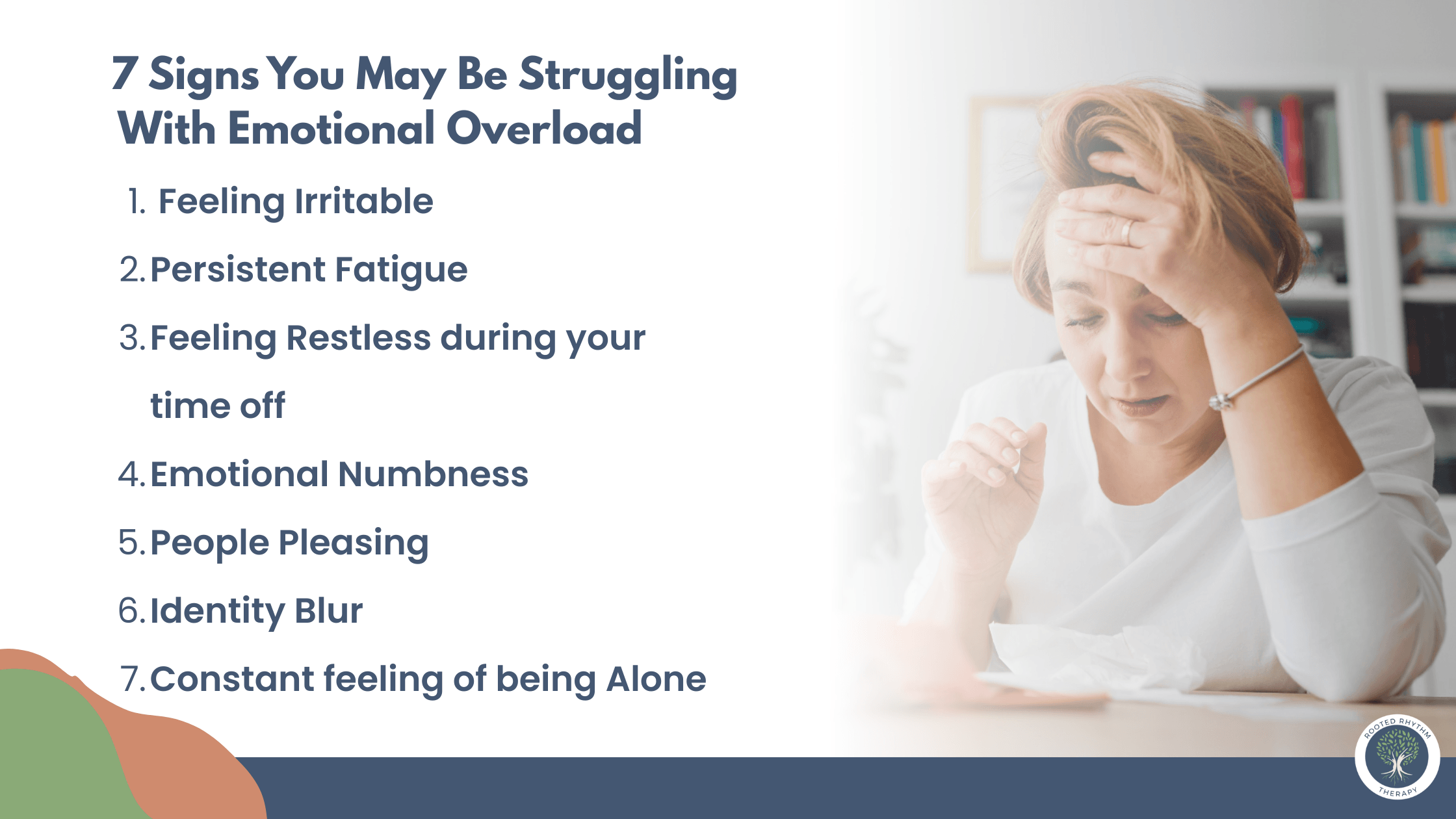
7 Subtle Signs You May Be Struggling With Emotional Overload
Irritability
You find yourself snapping at small things that wouldn’t bother you normally, like misplaced car keys!
Persistent Fatigue
Despite adequate sleep and time off, you still feel exhausted.
Restlessness
When you try to slow down in your life, guilt starts to creep in. You feel like you don’t deserve the time off and that you should be doing more.
Emotional Numbness
Nothing really excites you anymore. Moments that would normally bring you joy start feeling like a burden.
People Pleasing
You constantly find yourself in a position where you dismiss your own needs to put others first before your own.
Identity Blur
Your roles have become so consuming that you don’t know who you are outside of them. You struggle to answer when someone asks you what you need.
Loneliness
Emotional overload can bring with it a constant feeling of being alone, even when you’re surrounded by people that you love.
The Cost of Overfunctioning
Beyond the subtle signs, emotional overload can also show up in big, overt ways that deeply affect your interpersonal relationships. While juggling multiple roles as a woman and being there for others all the time, it is possible to feel unseen, unsupported, and unappreciated.
As you’re unable to communicate how you feel on the inside, resentment starts building up towards your loved ones, despite how dearly you care for them. This lack of acceptance of your emotions and lack of communication with your loved ones can easily leave you feeling more isolated than ever.
5 Ways of Combating Emotional Overload
Practise Acceptance
It is important to first recognize emotional overload as a valid and real response to prolonged stress and not a personal failure. This provides you with the grace and space for change.
Build Boundaries
When juggling too many things at once, it is important to know what you can and can not do. Start by building small boundaries for yourself. They do not have to be harsh, but can be as simple as saying ‘not today’ when faced with an extra task.
Rebalance Tasks
It is important to realize that emotional labour is as important a task as physical labour. Once you notice both of these, try to balance them equally in a day and delegate the tasks that you think are too much to handle together.
Regulate Your Nervous System
Adopting grounding practices like slow breathing, yoga, and taking up a sport that you like can all help you calm your nervous system. This is because emotional overload often lives in the body and manifests as body aches and weakness.
Seek Support
Find yourself a community that helps you figure out your tasks, that shows up for you because you don’t have to do everything by yourself. Even honest conversations can help you unpack your feelings and rebuild emotional stability.
What Role Does Therapy Play in Overcoming Emotional Overload
Practicing self-compassion can help women through tough emotional times. By tuning into their needs, taking a break when they feel necessary, and building soft boundaries, women can avoid emotional overload. However, in many instances, emotional overload becomes inevitable and very difficult to process. This is when it is completely okay to reach out for help.
Somatic therapy and trauma-informed approaches cater to women who may be experiencing emotional overload. This practice revolves around acceptance and recognition of chronic stress patterns that women may have built over time. It guides them towards bodily awareness and the way their nervous system responds to overstimulation. Eventually, it helps women connect with their needs and emotions.
At Rooted Rhythm, we offer somatic therapy that helps women experiencing emotional overwhelm reconnect with their bodies, regulate their stress habits, and find a way to reclaim their own space, in their own way.
FAQ:
Q1. What is emotional overload in women?
Emotional overload is a state of constant mental stress and emotional strain that usually develops due to juggling multiple responsibilities at the same time. It also develops when expectations from certain roles exceed the internal capacity that women hold.
Q2. How does juggling multiple roles affect women’s emotional health?
Juggling multiple roles firstly leads to exhaustion and anxiety, but can also turn into irritability and resentment in the long run. Eventually, women may start feeling disconnected and emotionally overloaded.
Q3. Why do women feel overwhelmed even when they’re managing everything successfully?
Regardless of how well a task is fulfilled, women find themselves in a constant state of emotional and physical alertness. This gradually piles up and leads to chronic fatigue and overwhelm.
Q4. Can therapy help with emotional overload in women?
Yes, it can! Therapy helps women in naming these patterns of overfunctioning that they wouldn’t normally recognize. Therapy also helps in building boundaries and regulating stress response.
Written by the Rooted Rhythm team, a women-centered therapy practice that supports women as they navigate emotional overload. Through somatic therapy, we help women untangle their emotional and physical stress to lead a balanced life.
Do you have a highly sensitive child?
We have created a course (Tuned In Parenting Course) that covers all from parenting techniques, to self-regulation, setting expectations, healthy boundaries and so much more. If you feel like starting with a sneak peak visit our Instagram page or check our mini courses: The Highly Sensitive Child and Parenting Essentials. We created these resources with care, and our hope is that they bring you clarity, support, and a sense of ease in your parenting journey.