
How can Self-Compassion for Women Help During Tough Emotional Times?

Many women facing tough times feel a variety of emotions. We all feel sadness, stress, and anger, but tough times also bring out a harsh inner voice that tells us that we should be handling things better or doing them differently. Women are also told to push through and stay composed during tough times despite emotional overwhelm. In such situations, self-compassion for women isn’t about ignoring the difficulties or the pain but rather about taking care of yourself first before you turn towards the world. Learning to meet yourself with kindness is a powerful form of healing that builds resilience and helps you thrive.
What Should Self-Compassion Mean for Women?
Emotional healing through self-compassion means letting go of the urge to ‘fix’ yourself, or to ‘toughen up’ when faced with difficulties. It also means to stay emotionally present with yourself without judgment and dismissal of your own feelings.
Self-compassion is the practice of responding to your pain with care rather than criticism. Very often, women take responsibility for everything happening around them. This leads to self-critical remarks like, ‘What is wrong with me?’ On the contrary, self-compassion allows you the space for gentler reflection instead, with questions like, ‘What do I need right now?’
Being accepting of your emotions is the first step towards practicing self-compassion!

Self-Compassion vs Self-Criticism: What’s the Difference?
To be able to take care of yourself during tough times, it is important that you know the difference between self-compassion and self-criticism. The differences are subtle, yet deeply impactful in how you respond to pain, stress, and self-doubt.
Self-criticism uses shame as a motivator, while self-compassion uses understanding.
Self-criticism narrows your emotional world, while self-compassion expands it by encouraging acceptance and allowing room for a different perspective.
Self-criticism disconnects you from yourself, while self-compassion builds trust by helping you respond to pain with care instead of judgment.
What Makes Self-Compassion so hard to practice?
Practicing self-compassion does not come naturally. This is not because they lack empathy, but because they have always been conditioned to direct that empathy outwards rather than inwards. Their emotional awareness, care, and kindness are reserved for everyone around them because, from a young age, they are taught and praised for being responsible for others. As a result, extending the same kindness to oneself starts feeling selfish.
Moreover, many women also find themselves to be perfectionists. But perfectionism often disguises itself as high standards when, in reality, it usually is the fear of letting others down or being seen as inadequate. In a culture that celebrates perfectionism, taking a pause or practicing self-kindness during emotional stress can be seen as an innate weakness or failure.
How Self-Compassion Supports Emotional Healing and Resilience
Practicing self-compassion can totally change how you navigate tough times and create space for healing. Here are some benefits of self-compassion for women:
Allows emotions to be felt safely: The practice of self-compassion demands that you first accept your emotions and create space for them. Sadness, anger, or exhaustion are all a part of your journey.
Regulates stress: Research claims that once you accept your emotions, you are better able to understand and respond to the tough times at hand. This practice helps regulate stress.
Softens shame: Self-compassion replaces harsh inner narratives that we often carry about ourselves with kindness and thus removes shame. This makes our emotions more manageable!
Builds inner trust: When we allow pain to co-exist with compassion, we are allowing ourselves to process our feelings while simultaneously dealing with challenges. This builds trust and helps us reconnect with ourselves.
Supports healing: Regularly practicing self-compassion helps transform our struggles into opportunities for growth and healing. Over time, it not only leads to emotional recovery but also deepens our connection with ourselves, fostering lasting inner support.
7 Practical Ways in Which Women Can Cultivate Self-Compassion During Tough Times
Take Self-Compassion Breaks:
During stressful moments when things get overwhelming, pause for a moment and acknowledge your feelings. Try saying to yourself, ‘This is an unexpected moment, and it’s okay to feel sad.’
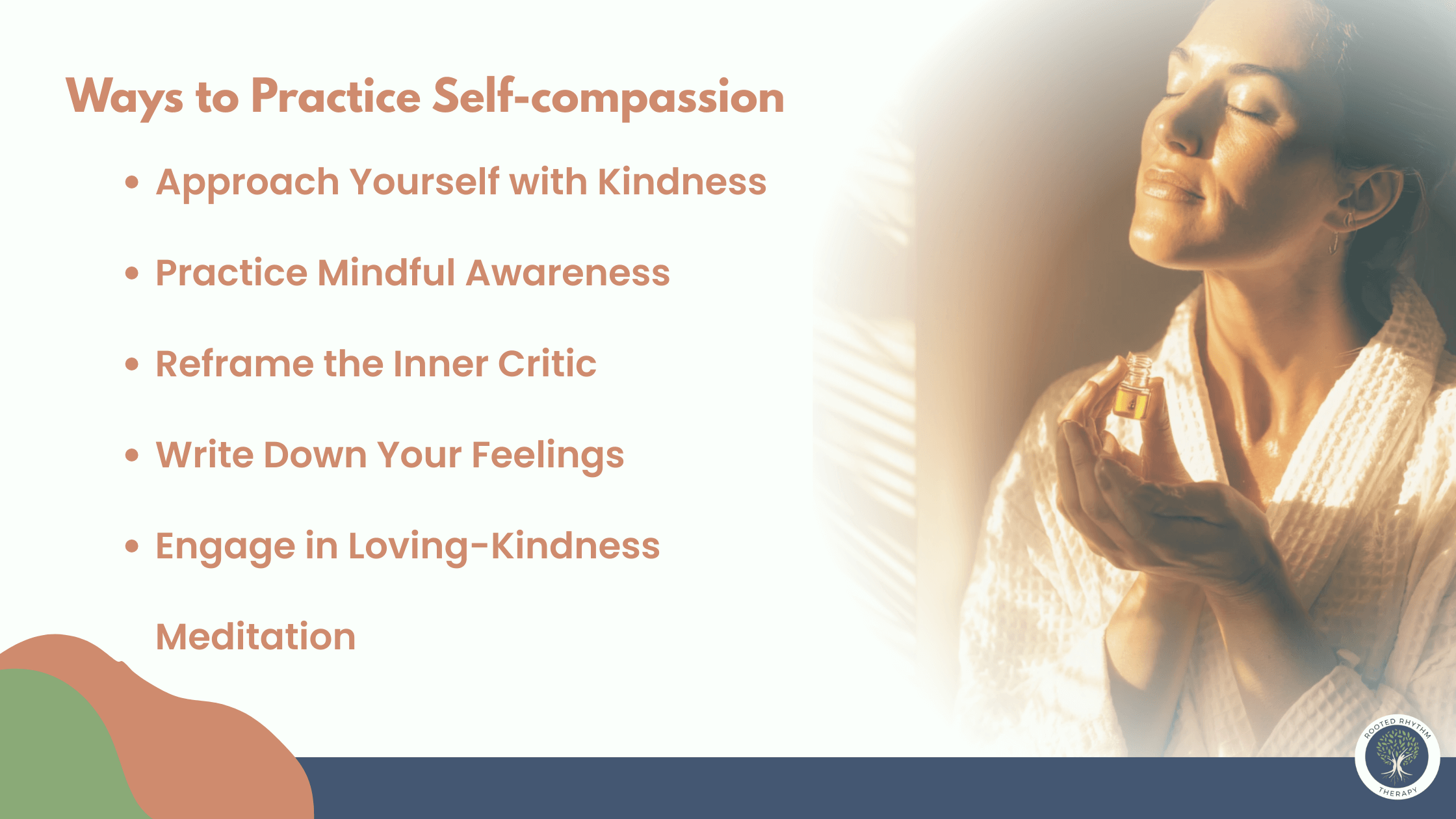
Approach Yourself with Kindness:
How you treat yourself in a tough time becomes a blueprint for how you will treat yourself in the future! So always try to use kind and supportive words for yourself, such as ‘I’m courageous and kind.’
Practice Mindful Awareness:
Don’t try to get rid of your emotions, because merely pushing them will not make them go away. Allow yourself to fully feel the sadness, anger and frustration. Be fully aware.
Reframe the Inner Critic:
Many women have a built-in critic that tells them that they’re not doing enough, or that they need to get over it. Whenever you sense your inner critic taking the center stage, brush it off and tell yourself, I’m doing the best I can.’
Feelings Journal:
Whenever confused or in doubt, write down your feelings. That might help you figure out how you’re really feeling. You can also use prompts such as, ‘How can I take care of myself today?’ to get started with your day positively.
Engage in Loving-Kindness Meditation:
This is a type of meditation where you repeat phrases like ‘May I be safe. May I be happy. May I be healthy.’ A few minutes of this meditation can really boost your confidence and provide strength.
Acts of Care:
There are different ways in which we feel nurtured. This could be a walk in the park, a warm bath, or the perfect cup of tea. No matter what form it takes, these small moments of care can help you remind yourself that your well-being matters.
The Role of Therapy in Cultivating Self-Compassion for Women
Self-help is an integral part of our everyday lives. When we are faced with difficulties, our first instinct is to try to fix them by ourselves. But sometimes when that is not enough, it is imperative that we reach out for help.
Similarly, in the process of building self-compassion, we must always take the first step ourselves. This can be through meditation, words of affirmation, and acts of care. But if we find ourselves in a position where these strategies are not enough, then we can always seek professional help.
In therapy, women are guided to notice their long-held patterns of self-criticism, which might go unnoticed. Relational, trauma-aware therapy can provide a safe space for exploring painful experiences without feeling overwhelmed or alone. Most importantly, receiving compassion from another human being can be profoundly healing. Part of self-compassion is learning to trust yourself again. Explore our daily self-trust practices for women!
At Rooted Rhythm, we offer therapy and self-compassion for women in a space that feels safe, supportive, and deeply human.
FAQ: Self-Compassion for Women
Q1: What does self-compassion for women really mean?
Self-compassion for women means responding to your pain with kindness and gentleness instead of criticism. It involves acknowledging tough emotions and dealing with them rather than trying to suppress them.
Q2: Why is self-compassion for women so difficult to practice?
Many women are conditioned to prioritize the feelings and needs of others from the very beginning. This puts their own well-being in the backseat, and thus, self-kindness starts to feel unfamiliar or selfish.
Q3: How can self-compassion for women support emotional healing?
Self-compassion creates space for emotional safety, which allows all feelings to be processed without shame or self-blame. This approach also supports nervous system regulation.
Q4: Can therapy really build self-compassion for women?
Yes! Therapy helps women recognize their harsh inner criticism and allows them to replace it with kindness and support. When you receive compassion from another person, it also makes it easier to extend it to yourself.
Written by the Rooted Rhythm team, a women-centered therapy practice supporting emotional healing, self-compassion, and inner resilience. We help women replace self-criticism with kindness and care.
Do you have a highly sensitive child?
We have created a course (Tuned In Parenting Course) that covers all from parenting techniques, to self-regulation, setting expectations, healthy boundaries and so much more. If you feel like starting with a sneak peak visit our Instagram page or check our mini courses: The Highly Sensitive Child and Parenting Essentials. We created these resources with care, and our hope is that they bring you clarity, support, and a sense of ease in your parenting journey.