
Why Saying No Feels So Hard: Understanding Guilt and Boundaries in Women

Saying “no” shouldn’t feel like a betrayal, but for many women, it does. The tension between guilt and boundaries in women runs deep, shaped by years of conditioning to be agreeable, helpful, and emotionally available. So when a woman sets a limit, even to protect her well-being, it can trigger an overwhelming sense of guilt as if she’s being selfish or letting someone down. But guilt isn’t always a sign you’ve done something wrong. Sometimes, it’s a sign you’re doing something new and necessary.
Why do boundaries in women often lead to guilt?
For many women, guilt and boundaries have never been allowed to coexist. From an early age, girls are praised for being agreeable, generous, and emotionally in tune with others but rarely encouraged to prioritize their own limits.
This early conditioning teaches women that their worth is tied to how much they give, how flexible they are, or how well they keep the peace. So when a boundary is needed, even a simple no, it can feel like a rejection of those roles. And that’s where the guilt creeps in.
Cultural narratives reinforce this conflict. Women are reported to have significantly greater shame and guilt tendencies than men. The “good woman” is endlessly available. The “strong woman” handles it all. Neither version makes space for rest, refusal, or self-protection.
This creates an emotional tug-of-war. You know you’re exhausted or stretched too thin, but you also fear being seen as selfish, cold, or difficult if you say no. Over time, this erodes self-trust and makes boundary-setting feel like a personal failure rather than an act of care.
Understanding this clash is the first step. Guilt doesn’t mean your boundary is wrong. It often means you’re rewriting a pattern that was never built to support your needs in the first place.
What are the signs of weak boundaries in women?
When guilt and boundaries collide, it rarely feels logical. It feels heavy, confusing, and deeply emotional.
You might set a boundary, then spend hours spiraling in self-doubt. Did I sound too harsh? Did I disappoint them? Should I have just said yes? Even when your boundary is clear and necessary, a wave of shame or discomfort can follow.
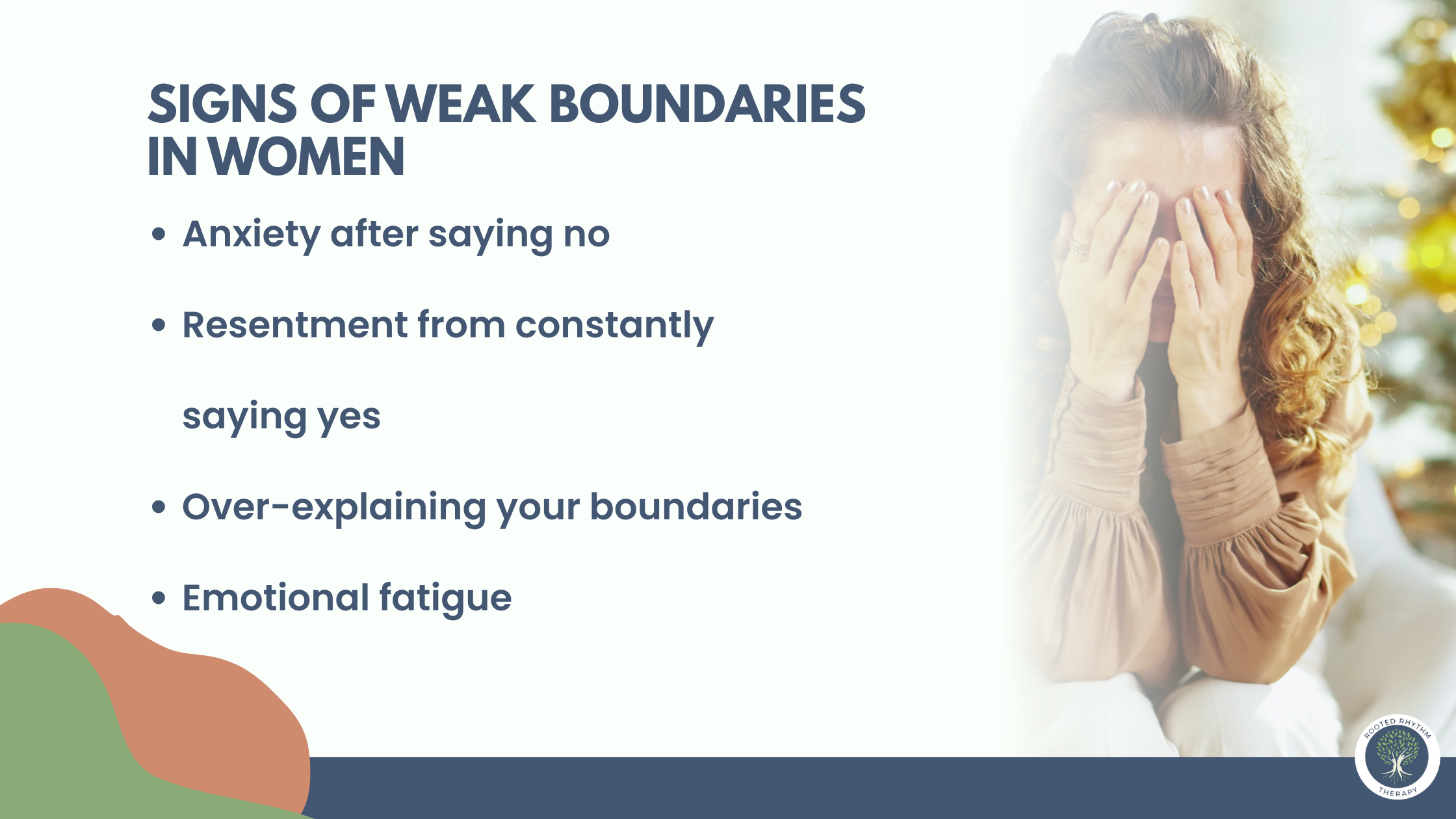
Here’s how it often shows up emotionally:
Anxiety after saying no, racing thoughts, tension, or second-guessing your decision.
Resentment from constantly saying yes when you mean no, a slow-burning frustration that builds over time.
Over-explaining your boundaries in hopes of being “understood” or “liked” instead of simply standing in your truth.
Emotional fatigue from carrying everyone’s needs while quietly ignoring your own.
These aren’t signs of weakness. They’re signs of conditioning, a reflection of how women have been taught to prioritize others over themselves.
It’s not the boundary that feels bad. It’s the guilt that was wired into your nervous system every time you were praised for selflessness, but never taught that your needs matter too.
Why is guilt around setting boundaries in women so common?
Because for many women, setting boundaries feels like breaking an unspoken rule: always be available, always say yes, and never disappoint.
This guilt doesn’t come from weakness; it comes from social conditioning. Women are raised to be caregivers, peacemakers, and emotional anchors for others. From family dynamics to workplace culture, the message is clear: your value lies in how much you give, not in how clearly you protect your energy.
So when a woman says no, takes space, or asks for what she needs, it triggers discomfort, not just in others, but in herself. That discomfort often gets mislabeled as guilt, when in reality, it’s the feeling of disrupting a role she was never meant to be trapped in.
Generational patterns reinforce this, too. Many women watched their mothers or grandmothers silently sacrifice their time, health, and well-being, and learned to do the same.
But guilt doesn’t always mean you’re doing something wrong. Sometimes, it means you’re doing something right, and unfamiliar. Boundaries aren’t a rejection of others. They’re a reclamation of self.
How can boundaries in women be strengthened and healed within relationships?
Boundaries don’t have to push people away; they can actually bring you closer to those who are safe to love you as you are.
Healing guilt and boundaries in women isn’t just an internal process. It often happens in relationships when you start practicing honesty, clarity, and self-respect in real-time with the people around you.
This kind of healing looks like:
Saying no without a long explanation, and noticing who respects that.
Letting go of relationships that only value your yes, not your truth.
Allowing discomfort to exist in the space between your boundary and someone else’s reaction.
Communicating from a place of self-awareness, not self-sacrifice.
Not all relationships will survive your boundaries. But the ones that do will become more honest, balanced, and emotionally nourishing.
The goal isn’t to have perfectly enforced boundaries. It’s to build relational safety where you can show up fully without guilt, and where your “no” is met with understanding instead of punishment.
Healing happens when you realize: you don’t have to earn love by overextending. You’re allowed to take up space, speak your needs, and still be deeply loved.
How can therapy help create boundaries in women without Guilt?
Therapy offers women what they rarely get in daily life: permission to center themselves without apology.
If you’ve been conditioned to believe that setting boundaries is selfish or that guilt means you’ve done something wrong, therapy can help untangle those beliefs. It gives you the space to explore your anger, your exhaustion, and your needs, without judgment or pressure to shrink.
In therapy, women learn that guilt is often a trauma echo, not a moral compass. You begin to see that feeling guilty doesn’t mean your boundary is bad. It means you’re stretching beyond a pattern of emotional over-responsibility.
Over time, therapy helps you:
Identify the beliefs that make boundaries feel unsafe
Learn how to tolerate discomfort without self-abandonment
Practice saying no with confidence and clarity
Reconnect with your body’s signals, so you can recognize when you’re nearing an emotional edge
If you're used to carrying everyone else’s needs, therapy becomes a space to finally ask: What about mine? Chronic boundary violations often lead to burnout. Learn how to spot and recover from burnout in women.
Rooted Rhythm offers compassionate, boundary-affirming support for women learning to trust themselves again, one “no” at a time!
FAQ: Guilt and Boundaries in Women
Q1. Why do women feel so guilty about setting boundaries?
Because many have been conditioned to believe that saying no or prioritizing themselves is selfish. Guilt often reflects that internalized belief, not the actual wrongness of the boundary.
Q2. What are the signs that a woman struggles with boundaries?
Saying yes too often, avoiding conflict, feeling responsible for others’ emotions, or over-explaining decisions are all signs of weak or unclear boundaries.
Q3. Can guilt and boundaries in women be healed through therapy?
Yes. Therapy helps women identify where guilt is rooted in old patterns and teaches tools to set boundaries with clarity, self-trust, and emotional resilience.
Q4. Is it normal to feel uncomfortable after setting a boundary?
Completely. Discomfort is part of breaking a pattern. But over time, that discomfort gives way to self-respect and relationships that honor your truth.
Written by the Rooted Rhythm team, a women-centered therapy practice supporting boundary work, emotional freedom, and healing from guilt. We help women say no with clarity, not shame.
Do you have a highly sensitive child?
We have created a course (Tuned In Parenting Course) that covers all from parenting techniques, to self-regulation, setting expectations, healthy boundaries and so much more. If you feel like starting with a sneak peak visit our Instagram page or check our mini courses: The Highly Sensitive Child and Parenting Essentials. We created these resources with care, and our hope is that they bring you clarity, support, and a sense of ease in your parenting journey.