
Why Life Feels So Intense When You’re a Highly Sensitive Woman and How to Cope

Life can feel unusually loud, fast, and emotionally intense when you’re a highly sensitive woman. You might pick up on subtle shifts in mood, feel deeply affected by other people’s emotions, or become overwhelmed in environments that others find manageable. This isn’t a flaw; it’s a biological temperament known as sensory processing sensitivity, which research confirms is a legitimate and deeply felt trait. When understood and supported, sensitivity can become a powerful strength, but without tools or validation, it can also feel like a constant emotional uphill climb.
Why does life feel so intense as a highly sensitive woman?
If you’ve ever wondered why bright lights, background noise, or emotionally charged conversations leave you drained, you’re not alone. For a highly sensitive woman, everyday life can feel like sensory and emotional overload.
Your nervous system isn’t wired to filter stimulation the way others might. You feel things, sounds, energy, facial expressions, even tension in a room, more deeply and all at once. This intensity isn’t imagined. It’s real, and it’s exhausting.
Emotionally, this can look like crying more easily, needing longer to recover from conflict, or feeling deeply unsettled by someone else’s pain. Even joyful events can be overwhelming; weddings, celebrations, or social gatherings may leave you needing hours (or days) to decompress.
This sensitivity also includes a deep sense of empathy and awareness. You notice what others miss. But that awareness can turn into emotional burnout if you're constantly absorbing what's not yours.
When the world feels “too much,” it’s not because you’re broken. It’s because you’re attuned. And while that can be beautiful, it also means you need different kinds of support to feel steady.
What makes a highly sensitive woman different from others?
Being a highly sensitive woman means your nervous system processes more. More detail, more emotion, more sensory input, and often, more deeply.
You’re likely the one who senses when something’s “off” in a room before anyone says a word. You might be deeply moved by art, music, or beauty, but also easily startled or overwhelmed in crowds, under pressure, or when rushed. It’s not about weakness; it’s about depth of processing and heightened awareness.
This trait also includes emotional intensity. You might feel shame more easily, reflect deeply on interactions, or take longer to “bounce back” from conflict. You may even mistake these experiences as personal flaws, especially in a world that praises toughness and speed over sensitivity.
Many highly sensitive women carry internalized shame, wondering why they can’t just “handle things” like everyone else. But the truth is, they’ve been handling more all along. This misunderstanding often leads to emotional fatigue and, over time, burnout, something we explore in-depth in our guide to burnout in women.
Emerging research continues to affirm that this level of sensitivity is not a disorder; it’s a temperament trait present in roughly 1 in 5 people. Recognizing that is the first step in shifting from self-doubt to self-acceptance.

How can highly sensitive women regulate their emotions?
When you’re a highly sensitive woman, your emotions don’t just come and go; they move through you like waves. And without support, those waves can knock you off center.
Emotional regulation doesn’t mean turning your feelings off. It means learning how to stay grounded while those feelings move through. That starts with awareness: noticing what triggers you, when you feel flooded, and what helps you come back to yourself.
Gentle tools work best for sensitive systems. Try:
Grounding techniques like placing your feet flat on the floor and breathing slowly.
Journaling to name what you’re feeling instead of holding it in.
Mindfulness to stay in the present, especially when your mind spirals into past or future worry.
Movement Even slow stretching can release emotional build-up.
Highly sensitive women are also more prone to emotional overwhelm because they absorb others’ energy. If you’ve been in a tense meeting, a crowded store, or a draining conversation, you might need time alone to recalibrate. That’s not avoidance, it’s nervous system maintenance.
Over time, regulation becomes a practice, not something you master, but something you return to. And if you need deeper support, therapy for highly sensitive women can help you build these tools with compassion and structure.
Is being a highly sensitive woman a disorder or a trait?
Let’s be clear: being a highly sensitive woman is not a disorder. It’s a temperament trait, one rooted in biology, not brokenness.
Known in research as sensory processing sensitivity, this trait describes a heightened responsiveness to stimuli, both internal and external. It shows up as emotional intensity, deep empathy, and a strong awareness of your surroundings. But it also means you're more susceptible to overwhelm, especially in fast-paced or emotionally charged environments.
What makes it confusing is that many highly sensitive women are misdiagnosed or misunderstood. Because sensitivity can lead to anxiety, depression, or burnout, especially without proper support, it often gets mistaken for those conditions. But the root is different.
High sensitivity is not something that needs to be “fixed.” It needs to be understood and supported. Once you realize it’s part of your nervous system’s design, not a flaw in your personality, you can begin to build a life that works with your sensitivity, not against it!
How can a highly sensitive woman protect her energy in daily life?
Protecting your energy as a highly sensitive woman isn’t selfish; it’s essential.
You process more, feel more, and notice more. That’s your strength. But it also means you need to be more intentional about what you take in and what you allow to drain you.
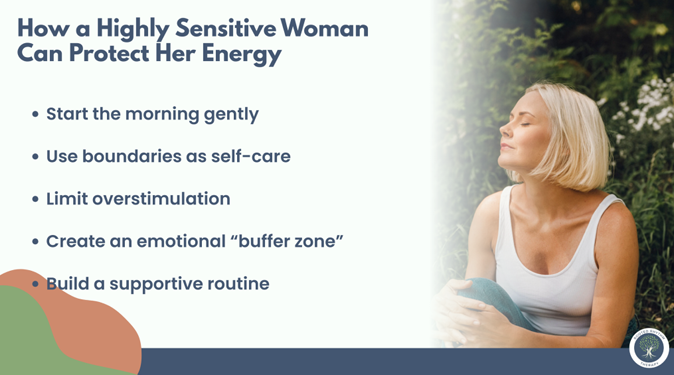
Here are a few ways to protect your energy day to day:
Start the morning gently. Avoid diving into emails or chaos first thing. Give yourself a few quiet moments to anchor before the world rushes in.
Use boundaries as self-care. Say no when needed, reschedule when overwhelmed, and step away when a space or conversation starts to feel too much.
Limit overstimulation. If crowded stores, loud places, or constant multitasking leave you depleted, plan recovery time; even 10 minutes of silence can reset your nervous system.
Create an emotional “buffer zone.” You don’t have to absorb everyone’s feelings. Practice visualizing a boundary between your emotions and theirs; it helps, especially if you’re highly empathic.
Build a supportive routine. Regular time in nature, mindful movement, and grounding rituals all help restore your baseline.
Remember: sensitivity doesn’t mean you’re fragile, it means you’re finely tuned. When you treat your system with respect, you can move through life with more steadiness and ease.
If you’re looking for tailored support, Rooted Rhythm offers therapeutic guidance designed specifically for highly sensitive women.
FAQ: Highly Sensitive Women
Q1. What defines a highly sensitive woman?
A highly sensitive woman has heightened emotional, sensory, and relational awareness. She often processes experiences deeply, feels others’ emotions intensely, and may become easily overstimulated in busy or loud environments.
Q2. Is being a highly sensitive woman the same as having anxiety or a disorder?
No. High sensitivity is a biologically based temperament trait, not a disorder. While it can overlap with anxiety or lead to burnout if unsupported, it’s not a mental illness.
Q3. How can therapy help a highly sensitive woman?
Therapy can teach emotional regulation, boundary-setting, and self-trust helping highly sensitive women build inner stability while honoring their depth and sensitivity.
Q4. What are the best coping strategies for a highly sensitive woman?
Grounding exercises, mindfulness, alone time, journaling, and reducing sensory input are effective strategies. The goal isn’t to toughen up; it’s to create environments where you can thrive as you are.
About Rooted Rhythm
Written by the Rooted Rhythm team, a therapy practice that supports highly sensitive women in embracing their emotional depth and building grounded, joyful lives. At Rooted Rhythm, we understand that being sensitive in a fast-moving world can be overwhelming, but it’s also a profound strength. Our trauma-informed, body-aware approach helps you navigate life without shutting down your sensitivity. If you're ready to feel more steady, connected, and supported, we’re here to walk with you!
Do you have a highly sensitive child?
We have created a course (Tuned In Parenting Course) that covers all from parenting techniques, to self-regulation, setting expectations, healthy boundaries and so much more. If you feel like starting with a sneak peak visit our Instagram page or check our mini courses: The Highly Sensitive Child and Parenting Essentials. We created these resources with care, and our hope is that they bring you clarity, support, and a sense of ease in your parenting journey.